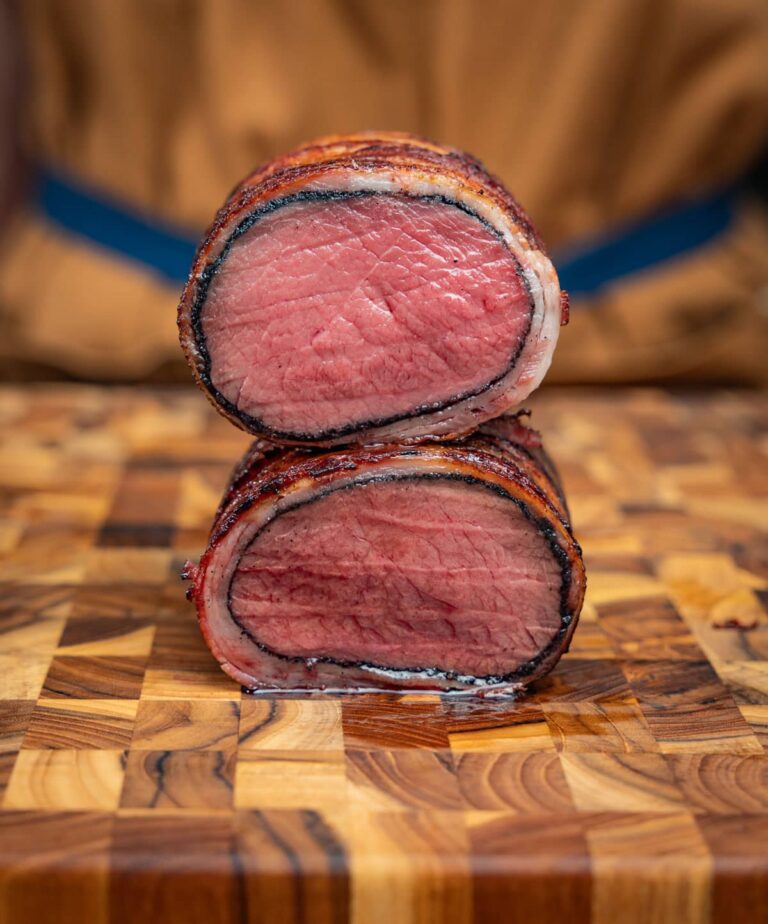
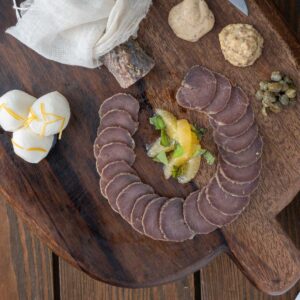
Lonza is one of the easiest and most delicious charcuterie preparations you can make.
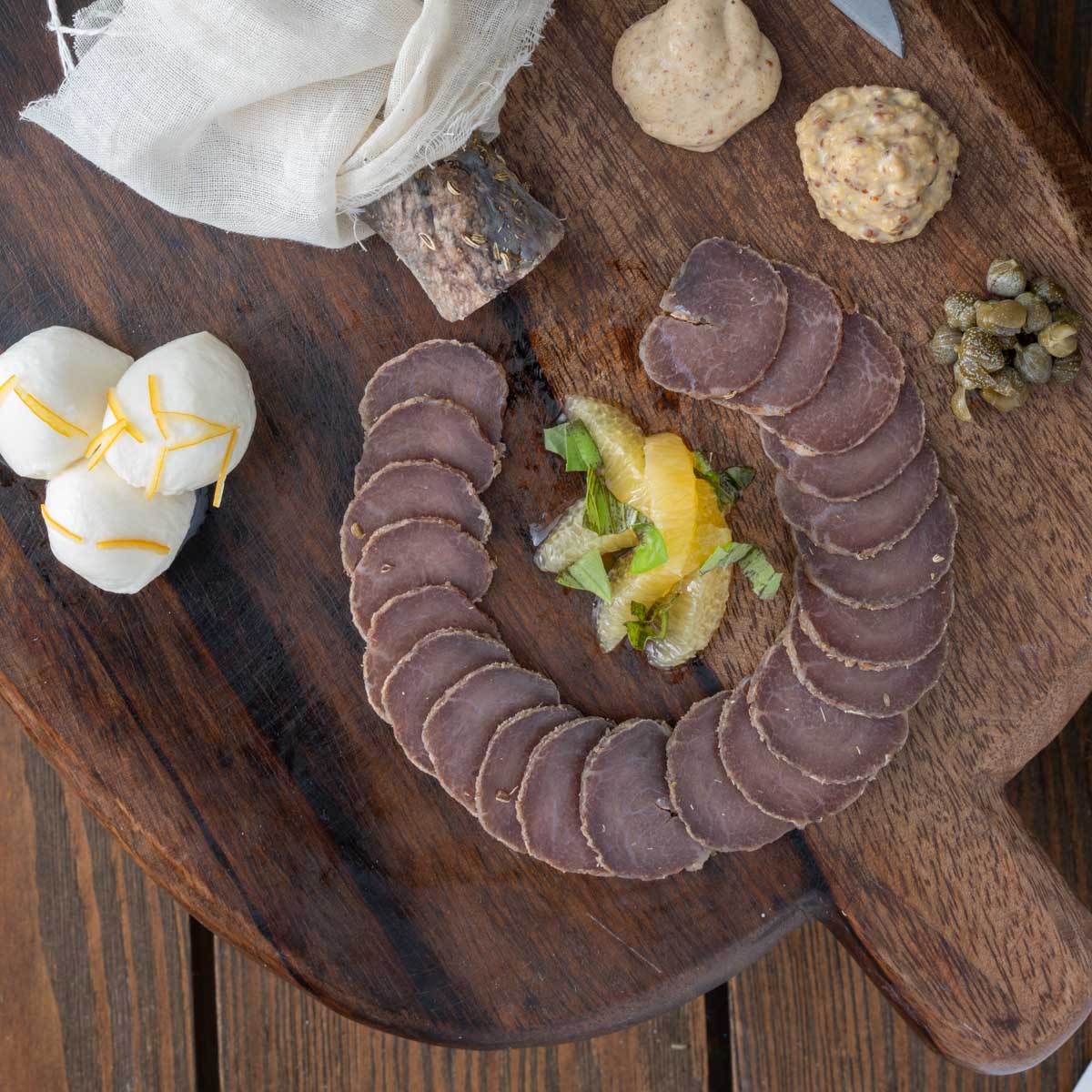
In the world of charcuterie, lonza (pork loin) is one of the simplest dry-cured meats that you can create. It’s salt, various seasonings, and drying time; that’s pretty much it.
You can play around with swapping out the herbs and other seasonings to your own taste buds. I like to season mine according to the “season” we are currently in. For holidays, I like to use juniper, thyme, rosemary and sage. I created this recipe in the warmer months, so I went with a citrus-and-garlic flavor profile.
Please check out the notes below before continuing with the recipe for equipment and safety precautions.
Food Safety Notes:
- Trichinosis: In order to to make this pork as safe as possible to eat, the CDC highly recommends that the meat be frozen at or below 5 degrees F, for a minimum of 20 days to render most of the larvae inert. And that means the center of the pork must be at or below 5 degrees F for at least 20 days.
- I have eaten cured wild boar that has been frozen this way many times. But it is completely up to you to make the final decision on whether you want to eat cured and uncooked wild pork.
- Here is a link to the CDC webpage regarding trichinosis to help you make your decision.
Equipment & Tools:
- Butchers twine
- Kitchen scale
- Food grade plastic bags
- Baking tray
Cooks Notes:
- Farm-raised pork loin is also a great option. And it’s the safest option if you don’t have properly handled and stored wild boar meat.
- If you don’t have access to a meat curing refrigerator, this recipe works well in a standard refrigerator as long as you have ample space and airflow.
- If you would like to have a rounded tubular shape to your lonza, try wrapping it tightly in a layer of cheesecloth secured with butcher’s twine.
- If you can’t get your hands on any Meyer lemons, oranges are a great substitute.
More Wild Game Recipes
- Easy Ground Venison Recipes
- Slow Cooker Venison Recipes
- Easy Venison Recipes
- Homemade Canadian Bacon
- Smoked Pork Chops
- Braised Pork Belly
Lastly, if you try this wild boar lonza recipe, be sure to leave a comment or tag me on Instagram! I thoroughly enjoy hearing feedback and checking out the photos of recipes that you’ve made.
Homemade Lonza
Ingredients
- 1 boneless wild boar or farm raised pork loin silver skin removed. (see notes for safety)
- kosher salt as needed
- 3 tbsp fennel seeds, toasted and crushed or cracked (for the cure)
- 1 Meyer lemon sliced thin
- juice of 1 Meyer lemon
- 5 garlic cloves finely chopped
- 2 sprigs of rosemary finely chopped
- 1 tbsp Fennel seeds toasted and finely ground (for the rub after after the salting is rinsed)
Instructions
- Weigh the pork loin and write down the starting weight. (Don’t skip this step–it’s critical for tracking weight loss during curing).
- Place the loin on a large sheet pan and coat it evenly with kosher salt, making sure every surface is well covered.
- Transfer the loin to a large food-safe plastic bag. Add the rosemary, garlic, Meyer lemon juice, and lemon slices, distributing the seasonings evenly around the meat.
- Roll the bag tightly so the salt and aromatics stay pressed against the loin.
- Set the bagged loin on a clean baking sheet. Place another pan of similar size on top, then add a weight (2-3 pounds) to press the loin evenly.
- Refrigerate for 1 day per 2 pounds of meat.
- Halfway through curing, flip the loin over. Rub the cure and seasonings back into the meat, roll it tight again, and return it to the press.
- When the curing time is complete, remove the loin from the bag. Rinse thoroughly under cold running water and pat completely dry.
- Rub the entire loin with ground fennel for a uniform, light coating.
- Tie the loin with butcher’s twine (as you would for a roast) so it can hang securely in your curing space.
- Hang the loin until it has lost 30% of its original raw weight that you recorded in step 1.
NOTES
- Write down the starting weight. This matters because the lonza is finished when it has lost 30 percent of its original raw weight.
- Salt every surface well. Coat the loin completely, then bag it with the Meyer lemon, garlic, rosemary, and juice so the cure stays pressed against the meat.
- Press it while curing. Set a second pan and 2 to 3 pounds of weight on top, then flip the loin halfway through and rub the cure back over the meat so it cures more evenly.
- Rinse and dry completely. After curing, rinse the loin well and pat it fully dry before rubbing it with the ground fennel and tying it to hang.
- Hang with good airflow. The post notes this can be done in a standard refrigerator if you have enough space and airflow, and cheesecloth is optional if you want a rounder shape.
- Use oranges if needed. The post specifically says oranges are a good substitute if you cannot get Meyer lemons Trichinosis: To make this pork as safe as possible to eat, the CDC highly recommends that the meat be frozen at or below 5 degrees F for a minimum of 20 days to render most of the larvae inert. And that means the center of the pork must be at or below 5 degrees F for at least 20 days.
- Here is a link to the CDC webpage regarding trichinosis.
- Curing (salting), drying, smoking, or microwaving meat alone does not consistently kill infective worms.
- Freezing wild game meats, unlike freezing pork products, may not effectively kill all worms because some worm species that infect wild game animals are freeze-resistant.
Nutrition
Nutrition information is automatically calculated, so should only be used as an approximation. Nutrition is per serving.